


I’ve been reading “Thanosis” (2025), by Jason Jorjani. Here I’m writing down some thoughts on the book. See also Yalda Mousavinia‘s thoughts and the book review titled “Promethean Voidwalker” by Esoteric Dixie Dharma, recommended by Jorjani.
Also listen to Jorjani explaining and commenting the book in this X Space. The conversation is also on YouTube.
As usual with Jorjani’s works, in this book I find extremely valuable insights, entangled with a mythology that I personally find unnecessary. But I know that many people find Jorjani’s mythology appealing to the point of addiction, so it can be a good viral vector for his metaphysical insights.
I’ve written down my thoughts on Jorjani’s philosophy. I like it a lot, with some caveats. Essentially, I’m only interested in what I call the “hard metafysiks” part of Jorjani’s thinking. I don’t care much for what I call his mythology (and previously I called his conspiracy theories), but this doesn’t prevent me from enjoying and resonating with his hard metafysiks.
So here’s a philosopher I like writing about “a radical philosophical investigation of life after death, integrating parapsychological data with an ontological framework.”
I do a lot of speculating on what the fuck happens to us, personally, after death. This is a deep existential issue to me. OK, I know that I’ll find out what the fuck happens to me after death soon enough, but my existential speculations are also intellectually fun.
So how could I not dive into Jorjani’s book and devour it cover to cover in a few days?
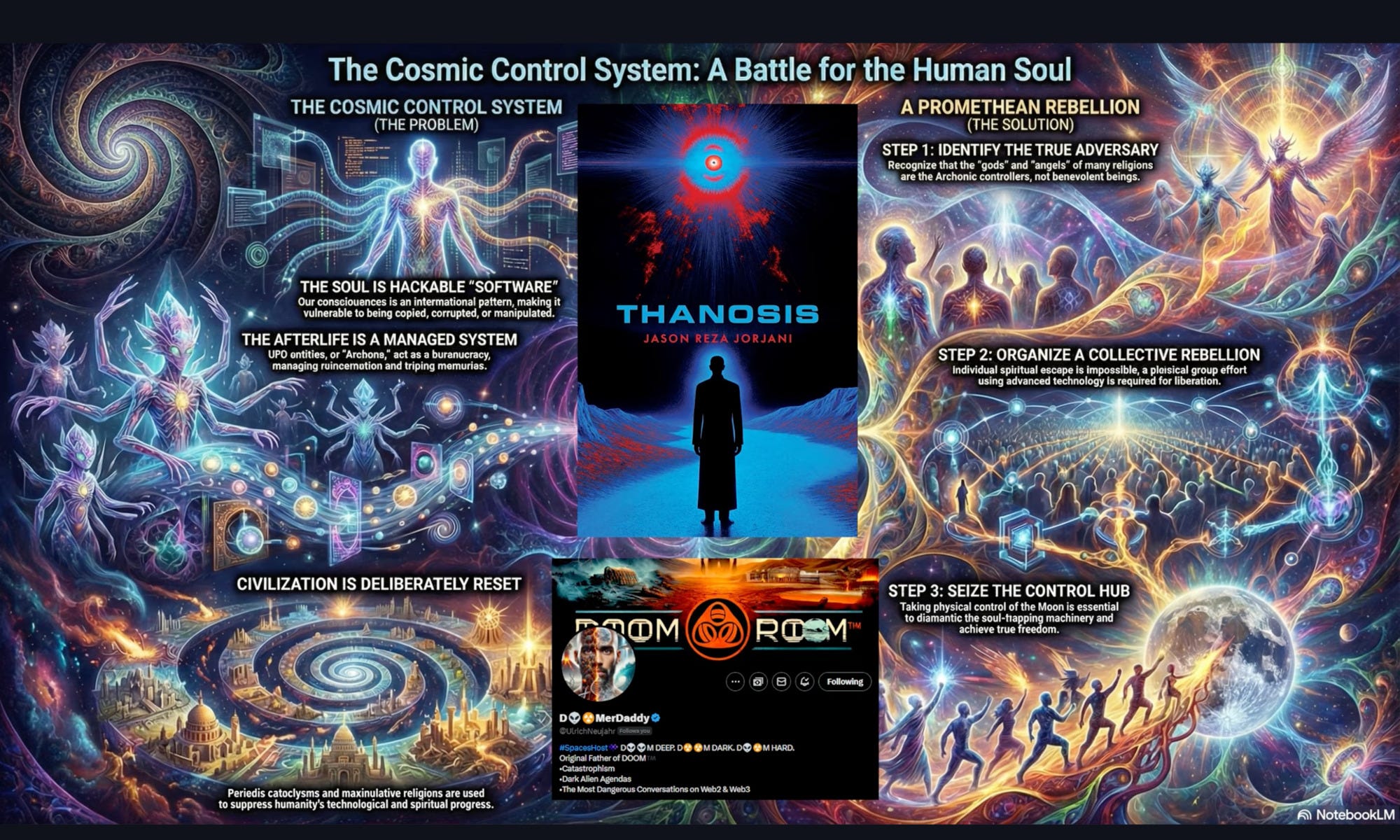
The cosmos according to Jorjani “is a quantum computational simulacrum… that generates and sustains the appearances of ‘selves’ and ‘worlds’ alike.” The simulacrum is a maelstrom of consciousness, energies, and forces that are manifest in the phenomena studied by parapsychology research. Jorjani uses the term “Psychotronics” for new science that would study, and new technology that would command, “the interaction of consciousness, energy, and matter.”
Jorjani includes a comprehensive review of parapsychology research suggesting that the soul returns to the psychotronic maelstrom after death. This doesn’t mean that the self is annihilated by dispersion in the all. On the contrary, after death the soul keeps a certain degree of coherence while it is pushed around by psychotronic winds and storms.
Jorjani’s cosmos is not a peaceful whole without conflicts. Rather, it is “a battlefield of minds… each contending, colliding, and co-creating reality.” The soul is a pattern of information in this cosmic battlefield.
The world’s religions are evaluated against the phenomenal evidence produced by parapsychology research. Most religions entirely fail Jorjani’s test, but Buddhism gets at least something right. In particular, Jorjani appreciates parts of the Tibetan Book of the Dead.
The world is a simulacrum, that is, some kind of simulation like the simulated universe (or multiverse) of Rizwan Virk, complete with “timeline revision within a system that also governs reincarnation, postmortem persistence, and future-life projections.” In the simulacrum, some kind of psychotronic machinery railroads souls through different lives.
Jorjani wants to be a real philosopher with a total philosophy that seamlessly integrates science, hard metaphysics, and mythology. So his vision comes with a mythology consistent with his previous works. The psychotronic energies and forces that railroad us through different lifetimes are overseen and controlled by archons “who have used a spectral or psychotronic technology in order to transcend linear space-time.”
Before recycling us into new bodies, the archons harvest our emotions (joy, fear, love, despair, rage etc.) like “honey being taken from bees.” This honey serves as some kind of fuel for the psychotronic machinery. The impression I get is that of a chicken farm operated by sadistic farmers.
I find this difficult to believe. There’s only one being endowed with general intelligence whose inner life I know - myself - and I’m not cruel or sadistic. I would never harm another sentient being just for fun.
I’m no saint, but I guess I’m more compassionate than a crocodile, and this single data point seems to suggest that intelligence and compassion go together. So I find it difficult to imagine ultra-super beings that are cruel and sadistic. Wouldn’t they have something better to do than torturing little helpless chicken like us?
But let’s go back to “Thanosis.” The chicken farm thing is bad news. But the good news is that we can escape the chicken farm. Reincarnation is a programmable process that can be hacked, provided we enter the afterlife “with the rigor of pilots rather than the passivity of livestock” and navigate the simulacrum along a path of our own choosing.
We can use psychotronic technology to do this. But like in his other works, Jorjani’s concept of technology blends into things that many people wouldn’t call technology. When we think of technology, most of us have in mind the machines and gadgets that we are familiar with, perhaps with some little or big improvements. But to Jorjani, “symbolic machines” made of symbols alone, without material technology that we would recognize as such, also work. John Campbell, the legendary editor of “Astounding” and the father of Golden Age science fiction, built symbolic machines that, according to him and other enthusiasts, worked.
I like Campbell, even if he said some bullshit now and then. I also like Jorjani. In particular, I like his generalized concept of technology and his view of technology as “ontologically prior to the natural phenomena” studied by science [Jorjani 2020]. Yet, a dumb physicist and engineer like me would like to see a conceptually clear bridge between the sci/tech of today and that of tomorrow. The essence of technology and science is that they help us make useful things. Psychotronics sounds totally useful, but how can we move from today’s sci/tech to psychotronics? What are the intermediate steps?
I’ve no in-principle objections to the idea that special rituals and symbols may unlock latent powers and enable us to do awesome things using the bare power of the mind alone, instead of conventional machines. Actually, I suspect this is the case indeed. But I would like some kind of explanation of how this may work, in my native language of today’s speculative sci/tech.
Jorjani uses scientific words like quantum entanglement and makes intriguing analogies with computer science, but he prefers to stay in the no-man’s land between science, metaphysics, and mythology.
However, his practical advice is to use the psychotronic technology of symbolic machines to train our mind and prepare to enter the afterlife as a Promethean hero, ready to kick some ass and take control from the archons. This requires “a paramilitary discipline of consciousness” and a mastery of the practical aspects of psychotronics. As sovereign souls, we can hack the simulacron and become programmers ourselves.
I love this! If we don’t like how the cosmos works, we can and must hack the cosmic machinery and make it do what we want. For this defiant and extremely important insight, I give five stars to Jorjani’s new book, and I forgive him for adding a dark mythology to his metaphysical insights. I agree with him on many things, including his appreciation of William James and his adamant dismissal of any model of reality that doesn’t make room for free will.
I read Jorjani’s mythology as science fiction, without taking it too seriously. But I see that others take it very seriously, to the point of addiction. I hope Jorjani’s dark and addictive mythology can be a viral vector for his overall metaphysics, which is essentially close to mine.