


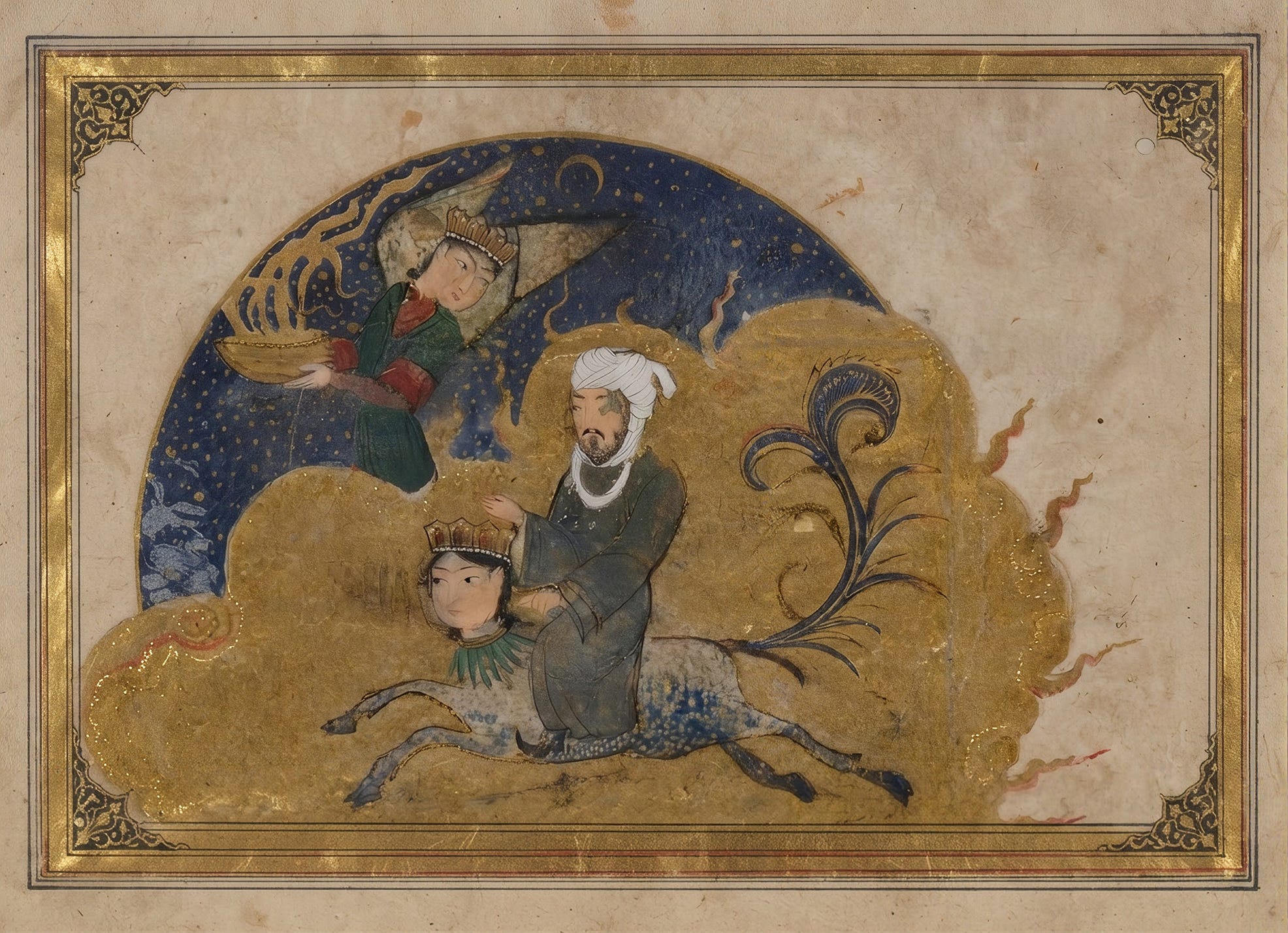
“Glory to Him who made His servant travel by night from the sacred place of worship (al-masjid al-haram) to the furthest place of worship (al-masjid al-aqsa), whose surroundings We have blessed, to show him some of Our signs: He alone is the All Hearing, the All Seeing.”
Quran, 17:1
This article, written by Dr. Brannon Wheeler, will be included in our debut print magazine BLAXXKY #1: THE FUTURE, SPACE, THE WEIRD & UNKNOWN, estimated to be shipped around March-June 2027. Preorder your copy now.
Did the prophet Muhammad have close encounters? The question is less strange than it may sound. Across the contemporary Muslim world, questions concerning intelligent extraterrestrial life and the UFO phenomenon find significant cultural and theological resonance. Although they are not widely studied from this perspective, Islamic texts and doctrines provide a wide array of symbols, narratives, and specific examples that are sometimes used by Muslims (and others) to support the claim that intelligent extraterrestrial life exists and has interacted with humanity (Khan 2008; Allgood 2024; Agrama 2018). By comparison, the non-existence of intelligent extraterrestrial life is a key tenet among many evangelical Christian writers on the UFO phenomenon. These evangelical authors—including Bob Larson, Timothy Dailey, and Gary Bates—often argue that while UFOs exist as a physical or spiritual reality, they are of demonic rather than extraterrestrial origin (Wheeler 2026). The Islamic tradition, however, offers an expansive cosmological landscape that readily accommodates diverse lifeforms and technologies without requiring them to be inherently malevolent.
The Mother Plane and Non-human Intelligences
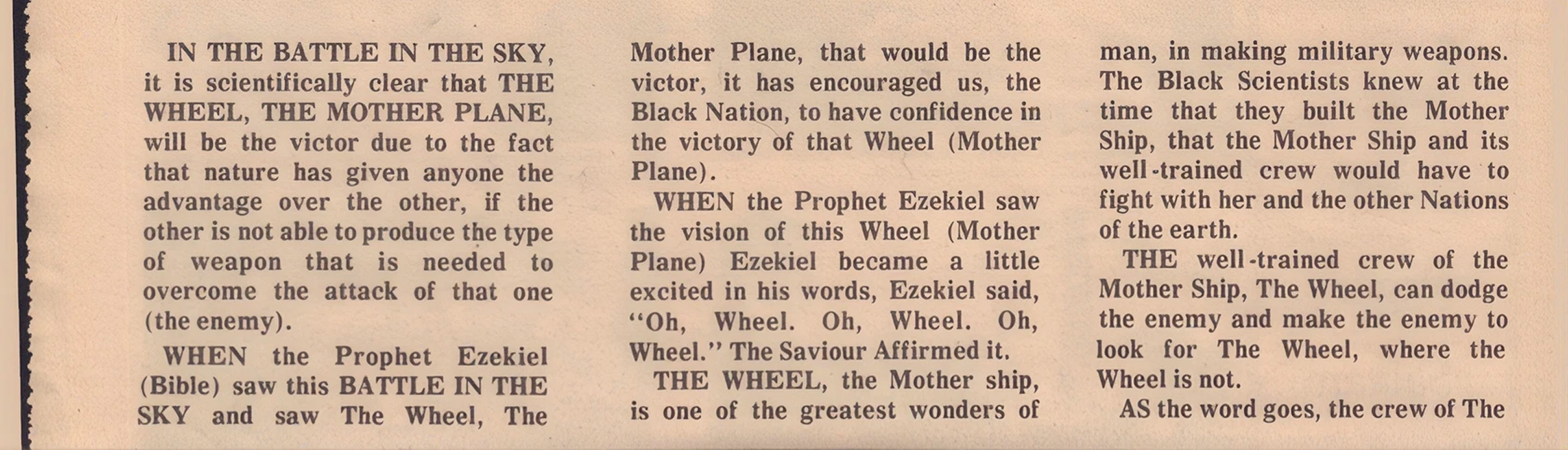
Parallel to the evangelical Christian view that anomalous craft are not alien, explicit belief in non-extraterrestrial spacecraft is a core tenet of some Muslim groups such as the Nation of Islam. Central to the Nation of Islam’s theology is the concept of the “Mother Plane”: a massive, circular craft, half a mile by half a mile, carrying some 1,500 “escort planes,” said to be the flying saucers people had been reporting. Wallace Fard Muhammad, the movement’s founder and original leader, taught that the vehicle was terrestrial rather than extraterrestrial in origin, built in Japan by “our Asiatic brothers” (Evanzz 1999).
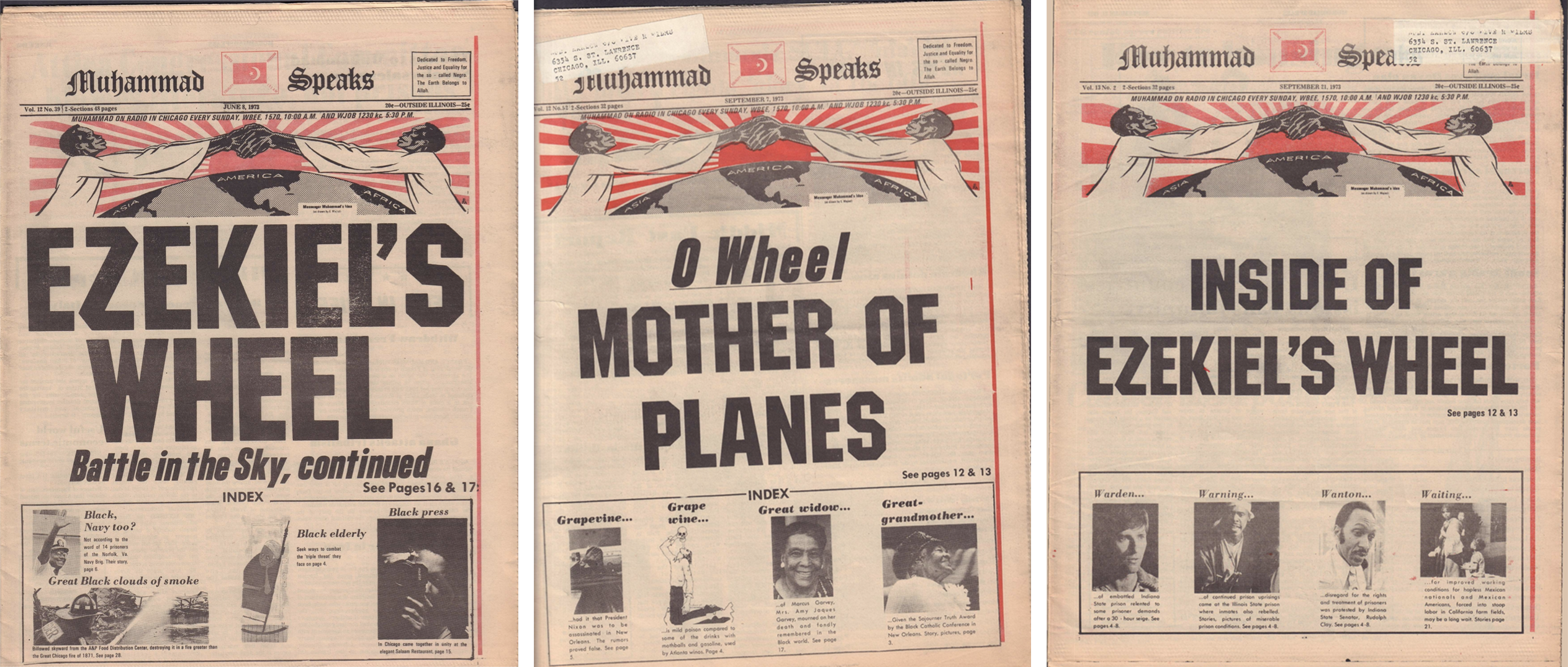
Carrying significant eschatological and soteriological weight, the vessel later became a cornerstone of teachings under Fard’s successor, Elijah Muhammad, who, following Fard, identified the Mother Plane with the “wheel within a wheel” witnessed in the biblical vision of the prophet Ezekiel.
“As I looked at the living creatures, I saw a wheel on the earth beside the living creatures, one for each of the four of them. As for the appearance of the wheels and their construction: their appearance was like the gleaming of beryl, and the four had the same form, their construction being something like a wheel within a wheel. When they moved, they moved in any of the four directions without veering as they moved.”
Ezekiel 1:15-17
Many Muslims, however, point to the fact that the Quran itself encourages belief in intelligent extraterrestrial life. For example, throughout the Quran, God is called “Lord of the Worlds” (rabb al-ʿālamīn), and surah 42:29 states that God created “living creatures” throughout the heavens:
“And among His signs is the creation of the heavens and the earth and whatever living creatures (dābbah) He has dispersed throughout them. And He has power to gather them when He wills.”
Classical Muslim exegetes often interpret these “living creatures” as angels, jinn, and other non-human intelligences, but some note that the Arabic term dābbah refers to “animals” or creatures that move across the earth (such as camels and horses) as well as an apocalyptic “beast.” Surah 27:82 describes this beast’s end-times emergence:
“When the verdict is given against them, We shall bring a creature out of the earth, which will tell them that people had no faith in Our revelations.”
The existence of angels and demons is, of course, known to many biblical and non-biblical religions. Yet Islam’s jinn (in English, genies) occupy a distinct ontological category: autonomous, intelligent beings that are neither inherently good nor evil, perhaps best described as “chaotic neutral” in their character. The Quran explicitly differentiates their nature from humanity’s in surah 55:14-15, declaring that God “created mankind out of dried clay, like pottery” and “the jinn out of smokeless fire.” This elemental distinction resurfaces in surah 7:12, where Iblis (Satan) justifies his refusal to bow to Adam by arguing, “I am better than him: You created me from fire and him from clay.”
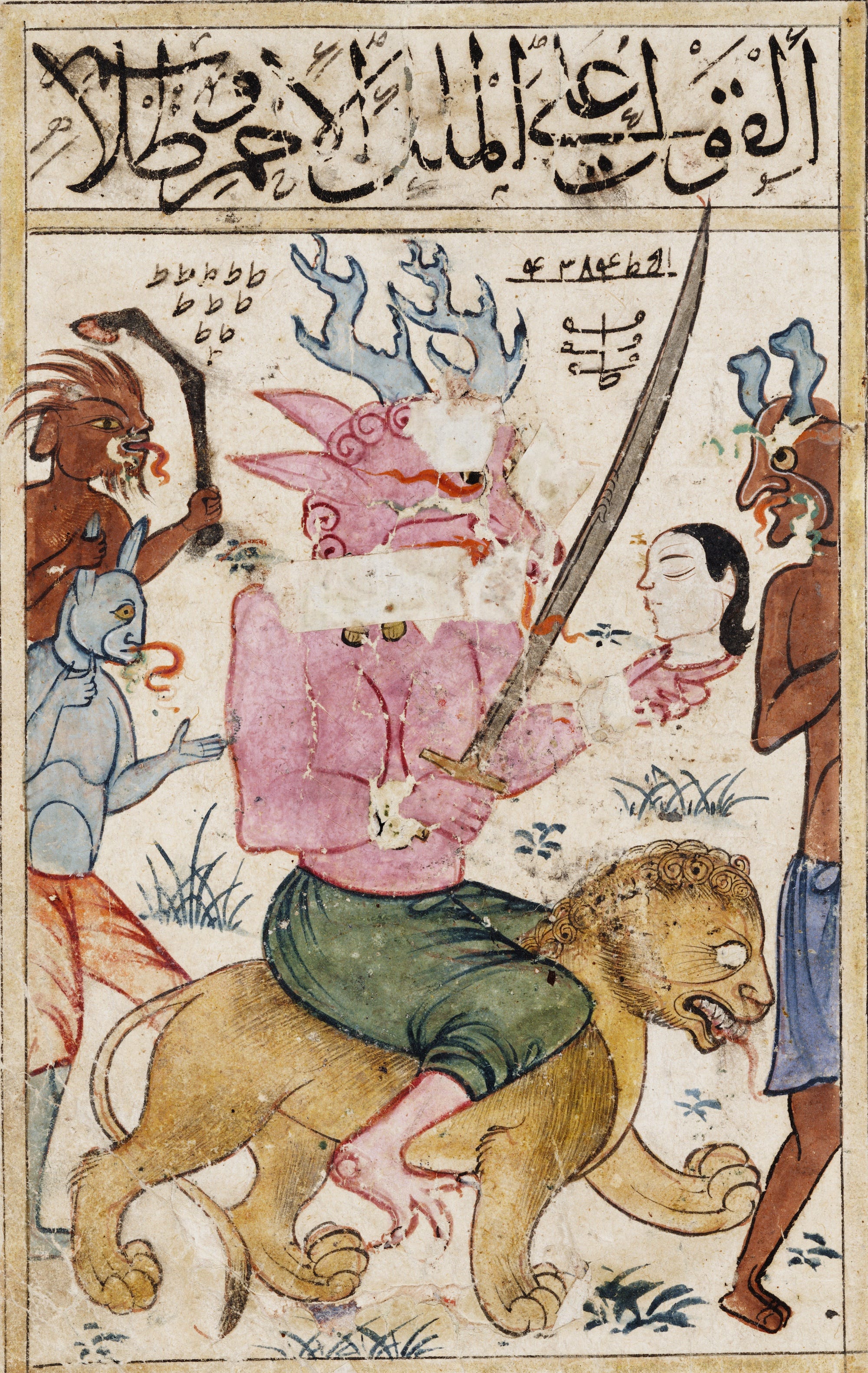
Many non-Muslim UFO researchers, including Jacques Vallée and Jim Semivan, have said that at least some UFO encounters might be attributed to jinn (Vallée 1969; Strieber 2022). In some interpretations of Islamic texts, jinn are thought to be tricksters from whom special protection must be sought (Hussein 2024; Lomas et al. 2024). Perhaps foreshadowing the evangelical position that UFOs are demonic, Muslim exegesis of the Quran states that the creature Iblis, who becomes Satan, was originally a jinn (Wheeler 2002).
There are more specific instances of traditional Islamic narratives and ideas that are sometimes interpreted in terms familiar to more modern UFO abduction experiences. The prophet Muhammad, for example, is reported to have been transported through the night sky from Mecca to Jerusalem by a winged creature called the “Buraq,” after which he ascended through the seven heavens, a two-stage voyage known as the Isrāʾ (night journey) and Miʿrāj (ascension). The Quran references the first stage in surah 17:1:
“Glory to Him who made His servant travel by night from the sacred place of worship (al-masjid al-haram) to the furthest place of worship (al-masjid al-aqsa), whose surroundings We have blessed, to show him some of Our signs: He alone is the All Hearing, the All Seeing.”
Canonical hadith literature expands on the creature’s otherworldly nature. In a narration recorded in Sahih Muslim (hadith 162a), Anas b. Malik recounts the prophet Muhammad’s description of the Buraq:
“I was brought al-Buraq Who is an animal white and long, larger than a donkey but smaller than a mule, who would place his hoof a distance equal to the range of vision. I mounted it and came to the Temple (Bait Maqdis in Jerusalem), then tethered it to the ring used by the prophets.”
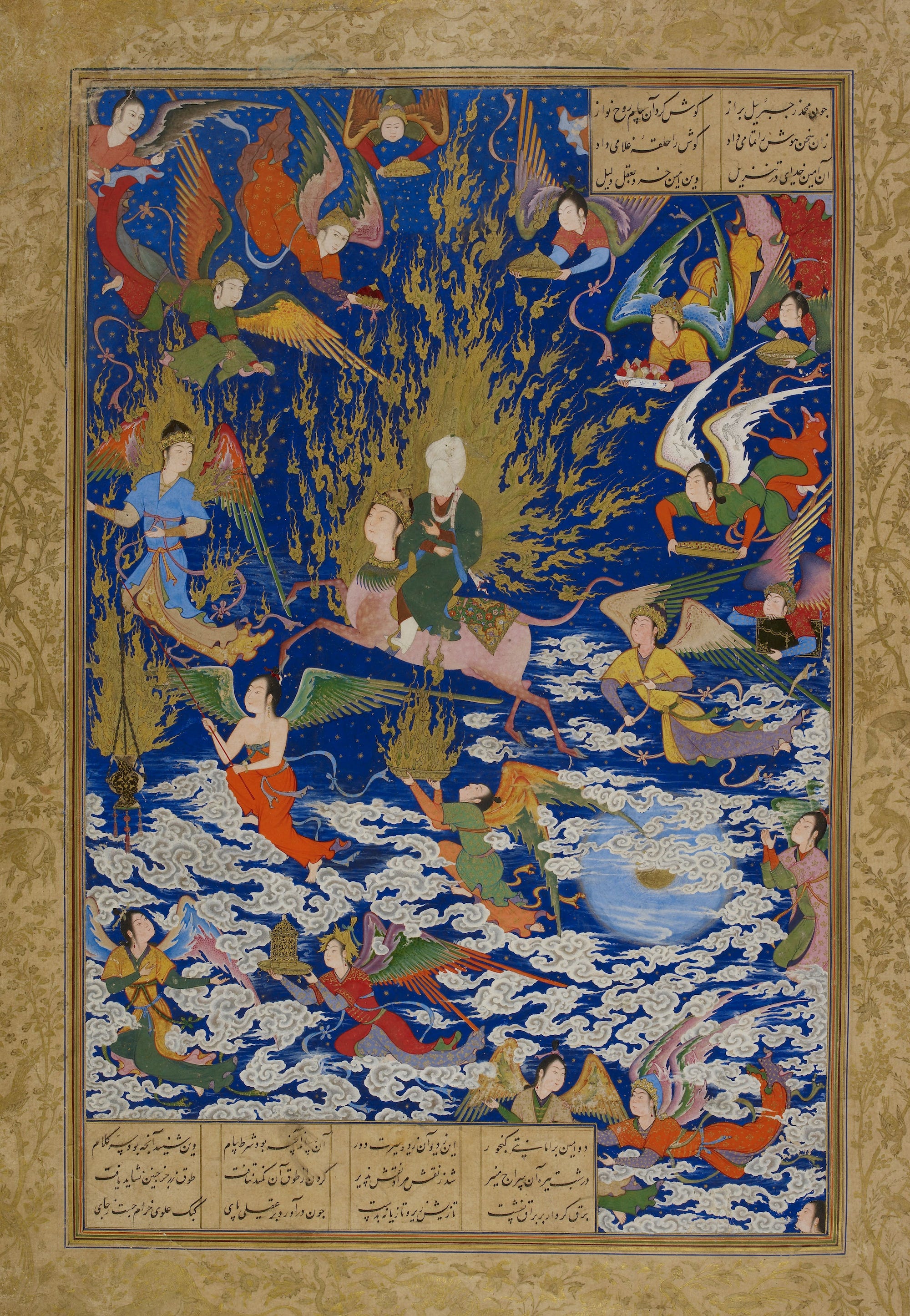
Lord of the Worlds
Drawing on the metaphysics of Ibn Sīnā, Suhrawardī, and Ibn al-ʿArabī, scholars have examined the ʿālam al-mithāl—an “intermediate realm” situated between earth and the heavens to which people can journey. As Henri Corbin observes in Spiritual Body and Celestial Earth (1977), this realm is populated by “archetypal celestial Figures which the active Imagination alone is able to apprehend,” an imaginative faculty that “unveils the hidden reality” rather than constructing “something unreal.” Corbin emphasizes that this realm is an ontologically concrete world containing subtle archetypes of material reality, reached not by bodily transit, but through visionary apperception.
Beyond this intermediate plane, however, Islamic theology also extends living creation to other realms of the physical cosmos. Consequently, some modern Muslim scholars argue that Islam is particularly well suited to accommodate belief in non-human extraterrestrial intelligent life (Hussein 2024). Unlike Christianity, in which a unique savior figure allows for redemption, Islamic theology holds that many thousands of prophets were sent, each with the same basic soteriological message. Other extraterrestrial civilizations could have received their own prophets carrying the same message as the one brought by Earth prophets (Allgood 2024).
This openness to intelligent life beyond a singular Earth is not merely a modern science fiction–inspired adaptation to Islam; it is grounded in both the Quran and centuries of Islamic scholarship. A foundational anchor appears in surah 65:12:
“It is God who created seven heavens and a similar [number] of earths. His command descends throughout them. So you should realize that He has power over all things and that His knowledge encompasses everything.”
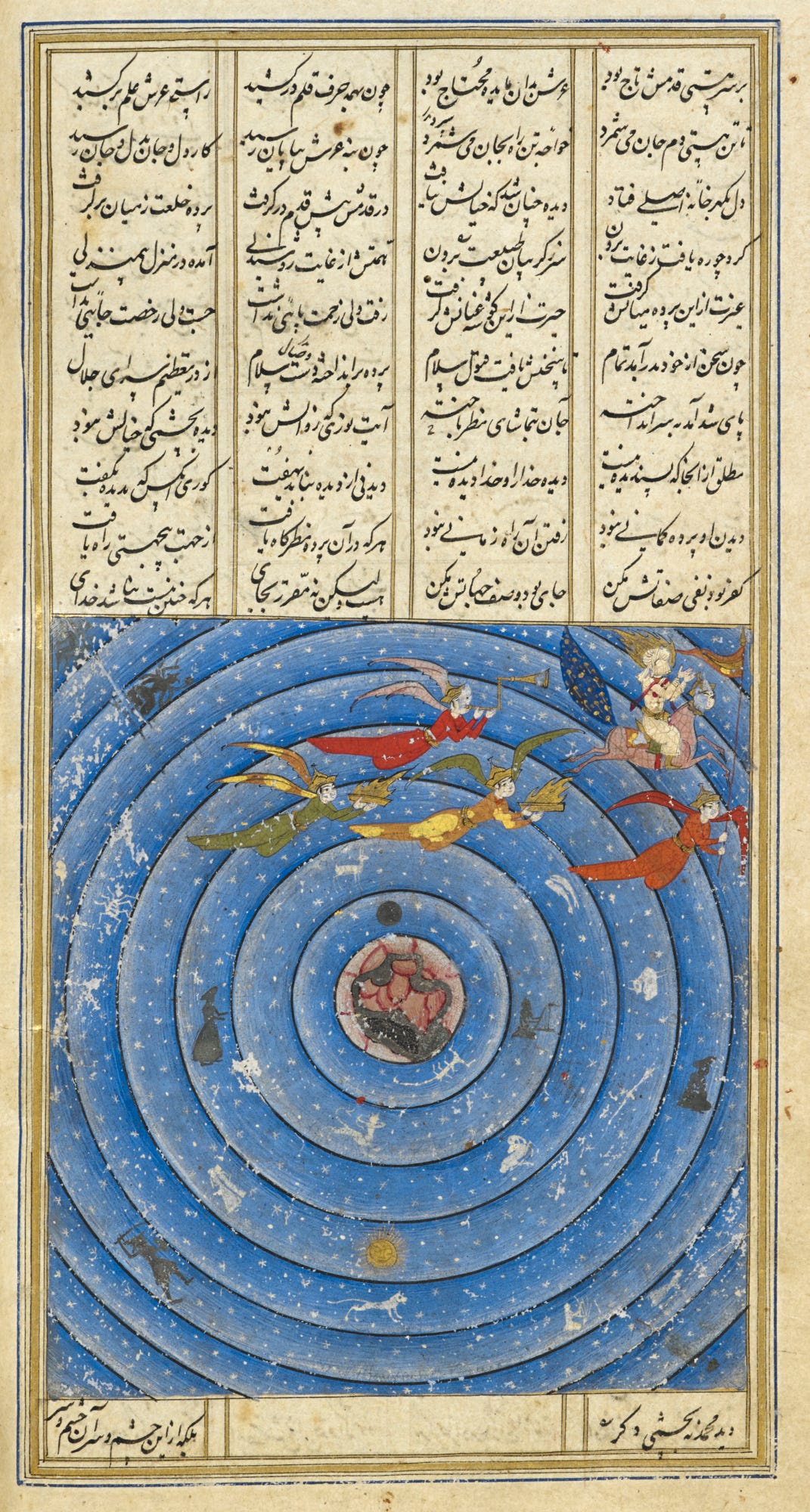
Medieval Muslim exegetes and polymaths drew upon verses such as this to engage in vigorous debates over cosmic pluralism (the doctrine that multiple, layered worlds inhabited by sentience exist throughout creation). This strand of exegesis dates back to the ninth and tenth centuries, appearing in the foundational commentary of Ibn Jarīr al-Ṭabarī (d. 923 CE). Commenting on surah 65:12 in his Jāmiʿ al-Bayān, al-Ṭabarī documents an early narration from the prophet Muhammad’s companion Ibn ʿAbbas, who maintained that “in every earth there is the like of Abraham, and the like of whatever creation is upon this earth.”
This pluralistic vision expanded during the Islamic Golden Age. The influential Persian theologian and polymath Fakhr al-Dīn al-Rāzī (d. 1210 CE) explicitly argued against the Aristotelian model of a single, closed cosmos. In his final theological treatise al-Maṭālib al-ʿĀliyah, al-Rāzī contended that God’s infinite creative power cannot be bounded by a single sphere. Citing the Quranic epithet for God, “Lord of the Worlds” (rabb al-ʿālamīn), al-Rāzī asserted that there exist “a thousand thousand worlds beyond this world,” each potentially larger and populated with its own orders of creation (Setia 2004).
Later scholars preserved an even more explicit variation of Ibn ʿAbbas’s report; in his exegesis al-Durr al-Manthūr, the Egyptian scholar Jalāl al-Dīn al-Suyūṭī (d. 1505 CE) records Ibn ʿAbbas stating, “There are seven earths: in each earth is a prophet like your Prophet, an Adam like your Adam, a Noah like your Noah, an Abraham like your Abraham, and a Jesus like your Jesus.”
While exegetes debated the literal versus allegorical weight of this statement, its survival within the classical exegetical tradition highlights an early willingness to conceptualize parallel worlds inhabited by moral, sentient beings receiving prophetic guidance—an idea that loosely anticipates, by over a thousand years, physicist Hugh Everett’s many-worlds interpretation of quantum mechanics (Everett 1957).
Furthermore, Islamic scripture actively resists anthropocentrism. In surah 40:57, the Quran declares, “The creation of the heavens and earth is greater by far than the creation of mankind, though most people do not know it.” The cosmos functions as an ever-expanding theater of divine signs (āyāt) rather than a stage centered exclusively on human redemption, and surah 42:29, cited earlier, counts the living creatures dispersed throughout the heavens among those signs. Viewed through this cosmological framework, intelligent life throughout the universe serves as a direct testament to divine order.
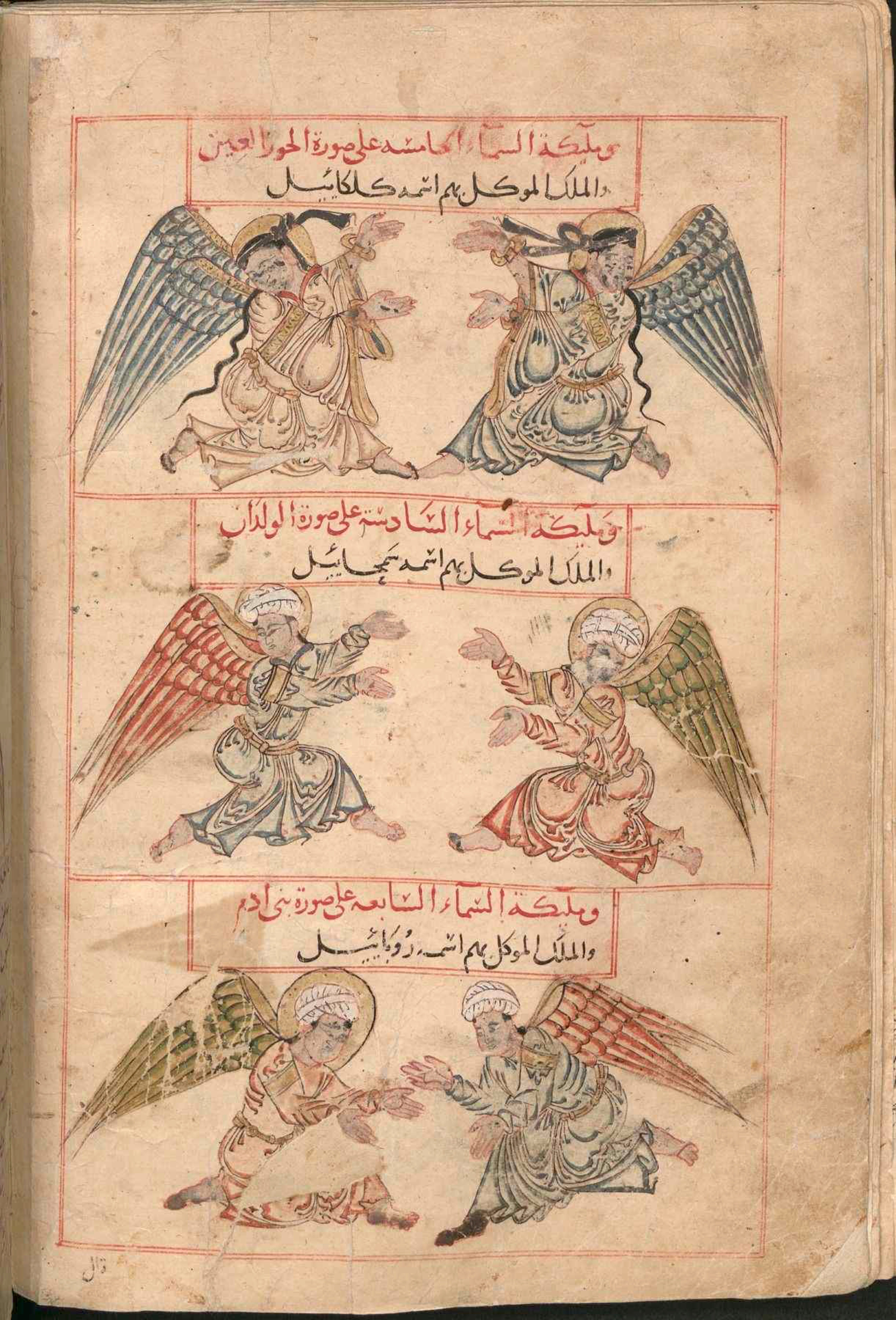
Conclusions
From the ontological neutrality of the jinn to medieval debates over cosmic pluralism, the Islamic archive presents a metaphysics layered with worlds (ʿālamīn) that physical observation alone cannot exhaust. Consequently, much more research is needed into Islamic interpretations of UFO-related experiences, alongside Islamic religious experiences that can be interpreted through a UFO lens. Future scholarship can explore this intersection by examining the rich medieval treatises on the mechanics of communication between humans and non-human intelligences (e.g., angels, demons, and jinn), coupled with Sufi accounts of visionary journeys into the intermediate realm (ʿālam al-mithāl). Such an inquiry may yield a far more comprehensive model for anomalous encounters that traverse the boundaries between extrasensory perception, subtle realities, and the human condition.
Brannon Wheeler is a historian of religion (PhD, University of Chicago) with over 40 years of experience studying religions, ancient texts, and paranormal phenomena. He has traveled to and done research in close to 100 countries across the world, conducting research in many unusual languages, and has been a visiting scholar at more than a dozen institutions in Europe, the Middle East, Asia, and across the United States. He is a member of the Visible College, and has published eleven books. His current work focuses on how non-human intelligences communicate with humans.
○○○
References
Quran translations are from Abdel Haleem (2005) or are the author’s own. The quotation from Ezekiel is from the New Revised Standard Version Updated Edition (NRSVue).
Abdel Haleem, M. A. S., trans. 2005. The Qur’an: A New Translation. Oxford: Oxford University Press.
Agrama, Hussein Ali. 2018. “Proximate Enigmas.” In “Science and the Soul: New Inquiries into Islamic Ethics,” The Immanent Frame, November 21, 2018. https://tif.ssrc.org/2018/11/21/proximate-enigmas/.
Allgood, Marcus. 2024. Muhammad, the Quran, and Alien Beings: Exploring the Mysteries of Extraterrestrials from the Islamic Tradition. N.p.: T.H.I.N.K. Publications.
Corbin, Henri. 1977. Spiritual Body and Celestial Earth: From Mazdean Iran to Shiʿite Iran. Translated by Nancy Pearson. Bollingen Series XCI, no. 2. Princeton, NJ: Princeton University Press.
Evanzz, Karl. 1999. The Messenger: The Rise and Fall of Elijah Muhammad. New York: Pantheon Books.
Everett, Hugh, III. 1957. “‘Relative State’ Formulation of Quantum Mechanics.” Reviews of Modern Physics 29 (3): 454-462.
Hussein, Imran. 2024. “The Jinn Hypothesis and Modern UFO Phenomena.” Sapience Institute, June 21, 2024. https://www.sapienceinstitute.org/jinn-hypothesis/.
Khan, Abdul Aziz. 2008. UFOs in the Quran. New York: Strategic Book Publishing.
Lomas, Tim, Brendan Case, and Michael P. Masters. 2024. “The Cryptoterrestrial Hypothesis: A Case for Scientific Openness to a Concealed Earthly Explanation for Unidentified Anomalous Phenomena.” Philosophy and Cosmology 33: 67-122. https://doi.org/10.29202/phil-cosm/33/3.
Muslim ibn al-Ḥajjāj al-Naysābūrī. 1976. Ṣaḥīḥ Muslim: Being Traditions of the Sayings and Doings of the Prophet Muhammad. Translated by Abdul Hamid Siddiqui. 4 vols. Lahore: Sh. Muhammad Ashraf.
al-Rāzī, Fakhr al-Dīn. 1987. al-Maṭālib al-ʿĀliyah min al-ʿIlm al-Ilāhī. Edited by Aḥmad Ḥijāzī al-Saqqā. 9 vols. Beirut: Dār al-Kitāb al-ʿArabī.
Setia, Adi. 2004. “Fakhr al-Din al-Razi on Physics and the Nature of the Physical World: A Preliminary Survey.” Islam & Science 2 (2): 161-180.
Strieber, Whitley, host. 2022. “CIA Officer Jim Semivan, His Close Encounter, His Take on the Phenomenon.” Dreamland (podcast), April 1, 2022. https://unknowncountry.com/dreamland/cia-officer-jim-semivan-his-close-encounter-his-take-on-the-phenomenon/.
al-Suyūṭī, Jalāl al-Dīn. 2003. al-Durr al-Manthūr fī al-Tafsīr bi-al-Maʾthūr. Edited by ʿAbd Allāh ibn ʿAbd al-Muḥsin al-Turkī. 17 vols. Cairo: Markaz Hijr.
al-Ṭabarī, Muḥammad ibn Jarīr. 2001. Jāmiʿ al-Bayān ʿan Taʾwīl Āy al-Qurʾān. Edited by ʿAbd Allāh ibn ʿAbd al-Muḥsin al-Turkī. 26 vols. Cairo: Dār Hijr.
Vallée, Jacques. 1969. Passport to Magonia: From Folklore to Flying Saucers. Chicago: Henry Regnery.
Wheeler, Brannon. 2002. Prophets in the Quran: An Introduction to the Quran and Muslim Exegesis. London: Continuum.
Wheeler, Brannon. 2026 (forthcoming). “Are UFOs Demonic? The Evangelical Christian Denial of Intelligent Extraterrestrial Life and the Myth of UFO Origins.” Cosmos and History.
Image Credits
Image 1: AI-generated image by BLAXXKY, after an illustration from Nizami's Makhzan al-asrar, the first book of his Khamsa (Five Poems), copied by Mir Ali ibn al-Yasi al-Tabrizi al-Bawargi, western Iran, 1388. The David Collection, Copenhagen.
Image 2: Front pages of Muhammad Speaks: “Ezekiel’s Wheel,” June 8, 1973 (vol. 12, no. 39); “O Wheel, Mother of Planes,” September 7, 1973 (vol. 12, no. 52); and “Inside of Ezekiel’s Wheel,” September 21, 1973 (vol. 13, no. 2). Via NOIWC – Nation of Islam Historical Archives Online (noiwc.info). Collage by BLAXXKY.
Image 3: Excerpt from Elijah Muhammad, “Ezekiel’s Wheel,” Muhammad Speaks, June 8, 1973 (vol. 12, no. 39). Via NOIWC – Nation of Islam Historical Archives Online (noiwc.info).
Image 4: Al-Aḥmar, the Red Jinn King of Tuesday, from Kitāb al-Bulhān, late 14th century. Bodleian Libraries, University of Oxford, MS. Bodl. Or. 133, fol. 31r. Public domain, via Wikimedia Commons.
Image 5: Ascribed to Sultan Muhammad, Ascent of the Prophet on Buraq to heaven, guided by Jibra’il and escorted by angels, from Nizami's Khamsa (Five Poems), 1539–1543. British Library, London, Or. 2265, fol. 195r. Public domain, via Wikimedia Commons.
Image 6: Talib Lala, from Nizami's Khamsa (Five Poems), Isfahan, Iran, 1665–1667. Courtesy British Library, Add. 6613, f. 3v.
Image 7: Al-Qazwini, ʿAjāʾib al-makhlūqāt (The Wonders of Creation), Wasit, Iraq, 1280. Bavarian State Library, Munich, Cod. arab. 464. Public domain, via Library of Congress.